01
Load a CSV
Drop an export or open a sample. Taxon reads the shape and finds the event column when it can.
Taxon 2.2 · local-first
Taxon turns a messy Amplitude, Mixpanel, Heap, PostHog, GA4, Segment, or warehouse CSV into one clean event list in the browser. Accept clusters, keep true variants apart, tidy property values like US / USA / United States, export a pack, then drop next month’s file and see what changed. Nothing uploads for cleaning.
For analytics teams who inherit messy event exports and need a reusable map, without uploading the file.
Taxon hands you files you can paste into docs and reuse next month.
Same four steps every time: load, decide, pack, compare next month. No account. No upload for cleaning.
01
Drop an export or open a sample. Taxon reads the shape and finds the event column when it can.
02
Near-duplicates group together: events, property keys, then the values under each key. Accept one canonical name, or keep true variants separate. Each cluster says why it was grouped.
03
Edit canonicals and notes in Preview pack, then download markdown, JSON, and a reusable map.
04
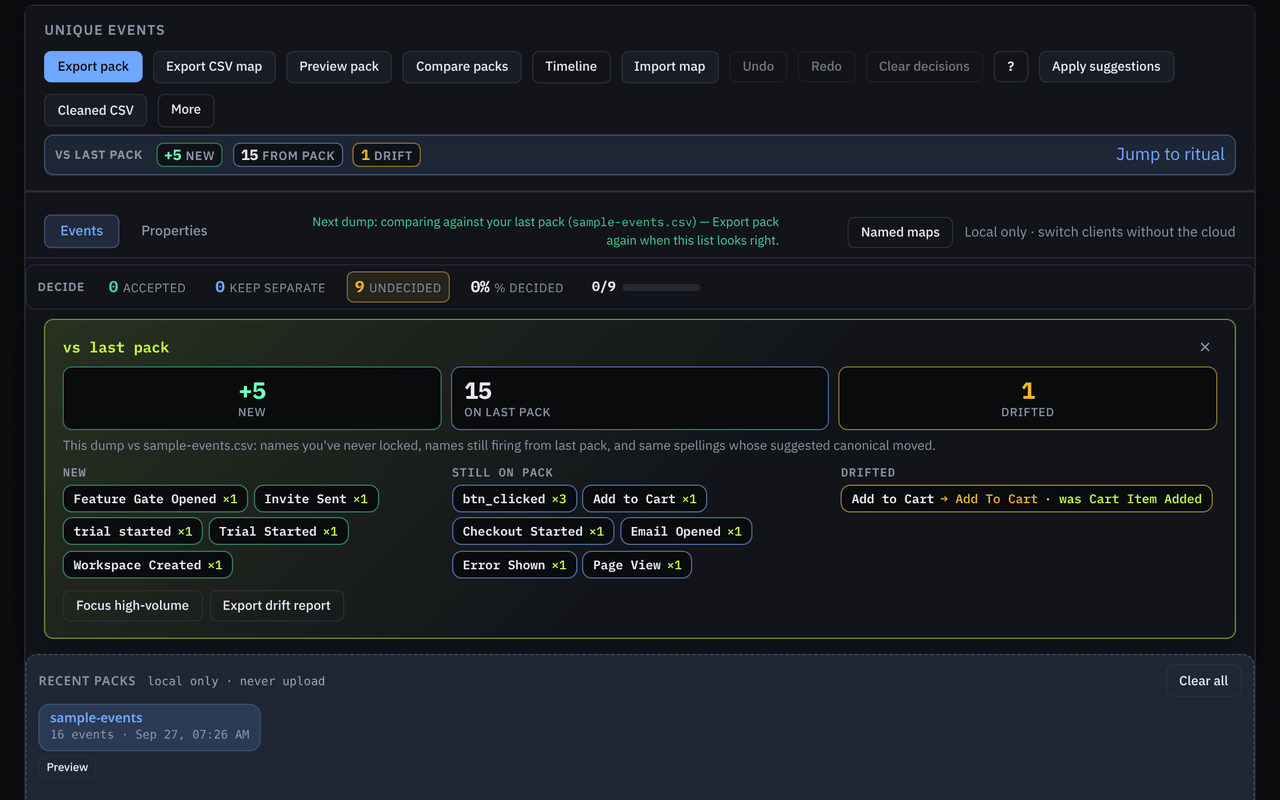
Drop the new dump against your last pack. See what’s new, still on pack, or silently drifted.
Events, properties and values, one tab at a time. Everything below works in Taxon 2.2.
Pull the same action under one name, without forcing merges that should stay apart.
Amplitude, Mixpanel, Heap, PostHog, GA4, Segment / Rudder-ish, and warehouse event lists. Taxon detects the export shape and picks the event column when confidence is high. Otherwise you pick the column.
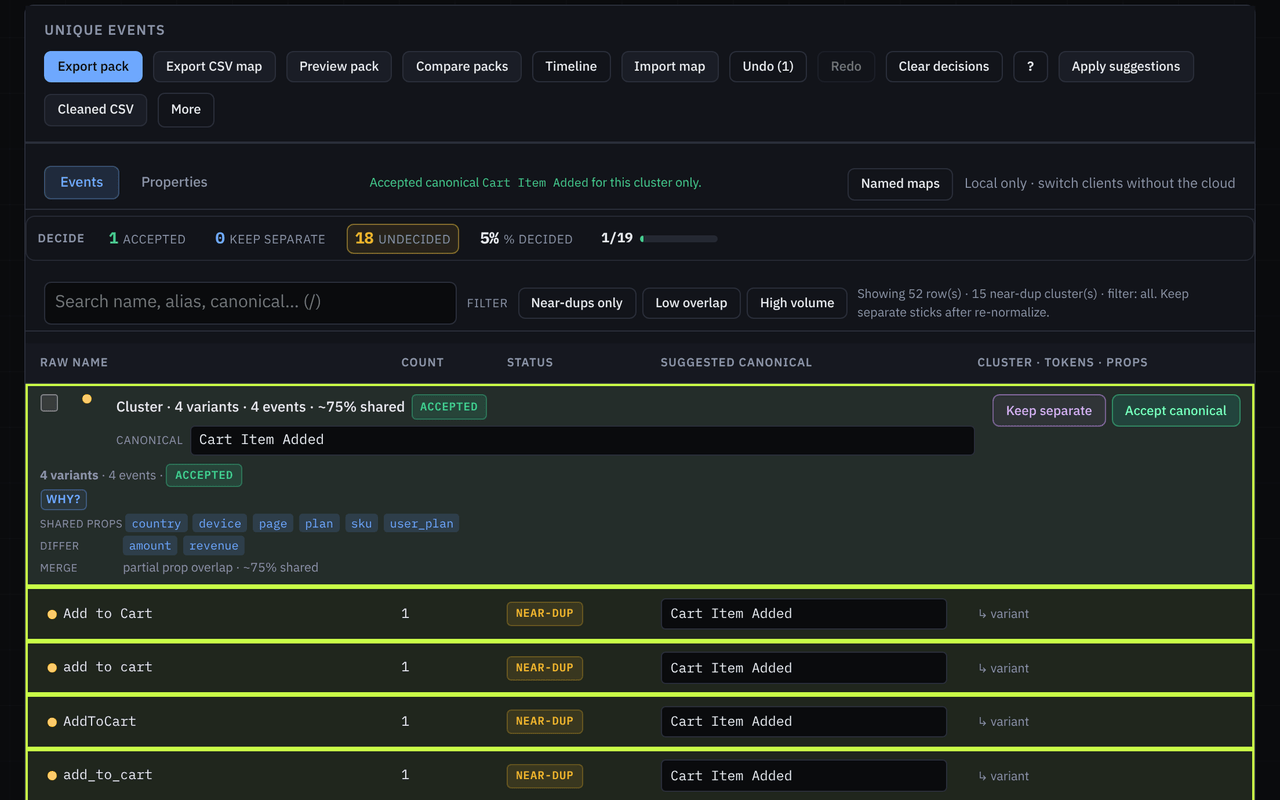
Add to Cart, add_to_cart, and AddToCart land in one cluster when they are really one action. Each cluster shows a plain why line: shared casing, synonym, verb form or phrase rewrite.
Accept a single canonical name for the cluster, or mark true variants Keep separate when props or intent differ. Keep-separate choices stick across re-normalize so Taxon does not keep asking the same question.
Near-duplicate property keys get the same cluster treatment on the Properties tab: accept, keep separate, and notes.
New in 2.2: the Values tab clusters the values under each property key. US, USA, U.S.A., and United States land in one cluster under country, with a plain why. Accept a canonical value or keep separate. Only keys settled on Properties get a value dictionary; IDs, emails, URLs, timestamps, and high-cardinality keys are skipped by default, each with a reason. Opposites like active and inactive never merge.
Default, SaaS, and Ecommerce synonym packs, plus optional custom token→expansion paste, so your house vocabulary can guide clustering without rewriting the file by hand.
Collision warnings, plain Why? explanations, and explicit map-conflict choices for events and properties when a prior map disagrees with a new cluster.
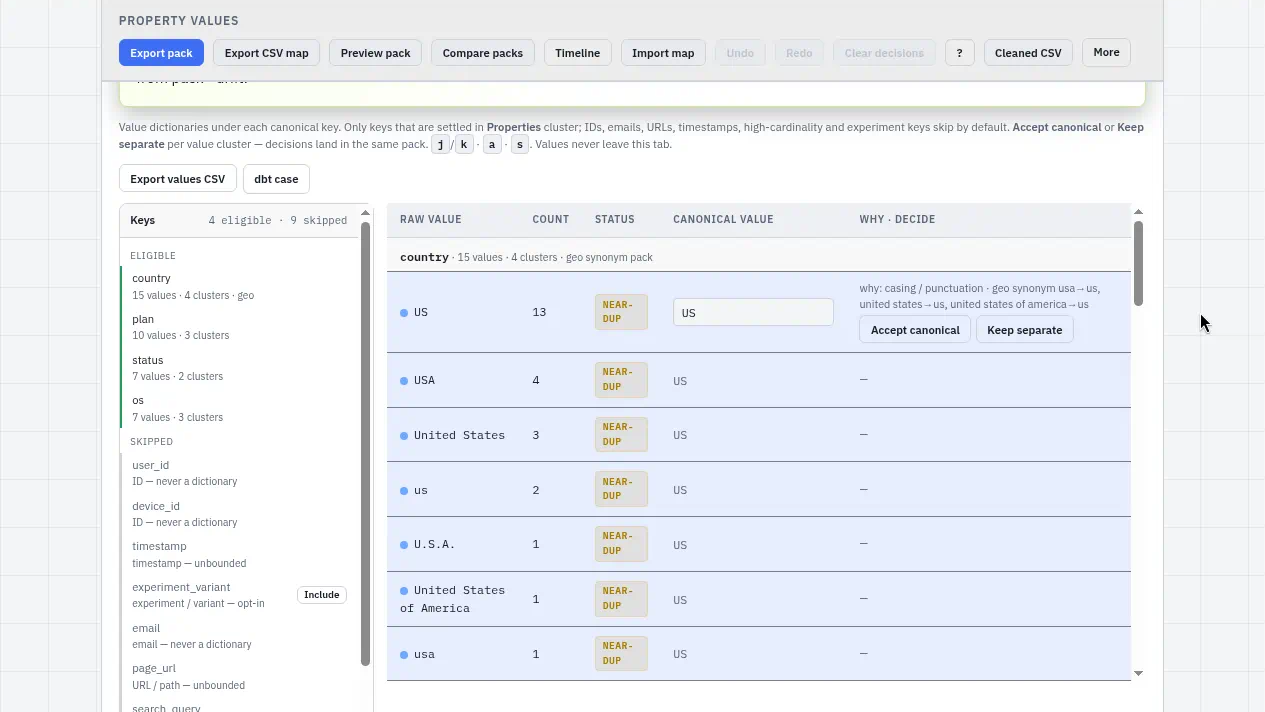
country spellings → US, with skipped ID / email keysLeave with something you can paste into docs, and bring it back next time so your decisions carry over.
Edit canonical event names, alias notes, property canonicals, and keep-separate notes in the tab before you export.
Download markdown, JSON and a map: pack text ready for Notion, plus a reusable taxon-map.json that carries accepts, keep-separates, and notes.
Export taxon-csv-map.csv from the pack pane (or CLI) for spreadsheet handoff when someone lives in Sheets, not JSON.
Bring a prior pack or map back so accepted names and keep-separate choices return with the next dump. Decisions are also remembered in this browser.
From the Values tab, export taxon-values.csv (key, raw value, canonical value, count, decision, why) and copy a plain dbt case snippet per key for accepted value clusters. Value decisions ride in the same pack JSON.
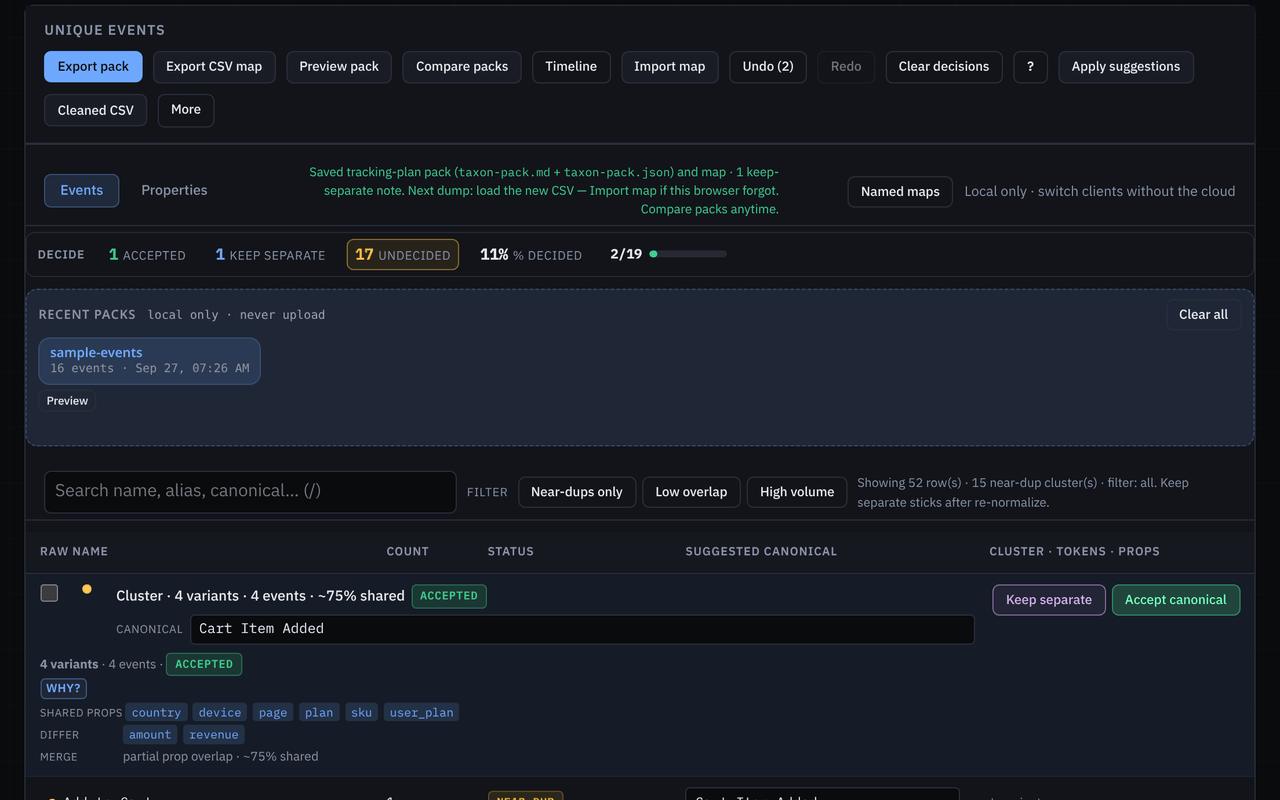
Compare next month’s file against your last pack. Taxon keeps your last pack locally and shows what changed.
On a new dump vs last pack: what’s new, what’s still on pack, and where names silently drifted. Sticky mini counts stay visible while you scroll long cluster lists.
Local pack history in this browser. Trend strip across consecutive points, and compare any two history packs, not only the latest pair.
From the changes banner, download a markdown + CSV drift report (new / on pack / drifted) for consultant or PM handoff.
On the Values tab, the next dump shows new values, values still on the last pack, and drifted values (a new U.S. under country shows as drift to US), plus stale keys that disappeared. Accepted and keep-separate value decisions carry over by key and value.
Named maps for multi-client work. Merge two maps without losing the conflicts you still need to judge.
Rename, duplicate, and pin last-used maps. Decisions stay on this device. The library is local storage, not a cloud account.
Move .map.json sets between machines with Export all zip / Import file or zip. The files never go to a server.
Union accepts and keep-separates, flag same raw → different canonical, then prefer Map A, Map B, or Manual pick on conflicts.
Cleaning never uploads your CSV. Taxon runs in the browser (or as a local CLI). We only count anonymous page views, not file contents. Maps and Month-N history live in this browser until you export them.
Guided pass on a sample, or open Taxon and drop your own CSV. Worked example if you want the story first.